Showing posts with label artinstallation. Show all posts

Sunday, 5 March 2023

Mapping Sloughing

I'm studying MA Contemporary Art & Archaeology part-time and therefore my attention has been taken up with lots of writing in a journal and not so much on the blog. It has been very absorbing and helpful. Leading me to think about the found object collections I make and subsequent assemblage works as a kind of conceptual mapping. Not in any way topographical or geographical representations of space, but how feelings about being in certain spaces and how this related to how I thought the objects I found gathered together.

For this recent open studio I constructed a hanging hoizontal grid and played around with a couple of older collections I'd made quite near the studio. Mapping, now realigned, enabled things in the map to relate to each other as well as to my memory of how I found them. Different species of maple leaves were kept apart, pine needles formed a row like the row of pine trees alongside the trainline from whence they came, plastic headphone casing cradled smashed headlight plastic because I thought of how that might sound that whenever I saw them. But there were visual groupings that related only to each other - circles and colour related maps that were woven into the whole - where I was thinking about those collecting walks, archaeologists call them 'walkover surveys', where the first thing I'd picked up became set a key for all the other things I was drawn to subsequently.

Adding an Arduino powered servo which hit the grid repeatedly made all the things move and shimmer and I amused myself during the day with adding more things and changing the tempo of the servo. It didn't take much might to make everything in the grid move just a little bit - some pushed a little each time until they fell off. 

I seemed to have re-attuned myself over the day. That night I didn't sleep well, constantly visualising little bits of stuff vibrating. Kept catching sight of things possibly moving out of the corner of my eye. Fortunately it only lasted one night!

Since this, I've been thinking more about mapping and specific experience of place. I've been limiting my collections to one walkover and then seeing what I can make. This has co-incided with the seasonal dropping of tree and shrub twigs - they dropped their leaves in January - which is fine material to make grids with. I have dogwood, birch and mistletoe. And I've gone back to using scanners as a way to document and create further grids to accentuate the action of watching and recording.

Friday, 12 August 2022

Stalemate


I saw the remains of this hawthorn which has become impaled upon a galvanised steel fence between industrial road and rail track. The tree with its limbs pinned in the fence, scalped by the rail workers who were eating lunch by their vans down the way having just finished tidying up when I passed by, seemed to me an allegory of the embeddness of human structures in an organic world rather than the other way around. 

As an organic intervention in the metal grid requiring branches to become involved in the fence I was reminded of the failed freedom of Steve McQueen’s character in The Great Escape; caught up in razor-wire with the motorbike engine still pointlessly throbbing. I’m Generation X and this to me is an iconic image of failure of the individual despite determined action against a larger, organised and well-equipped foe. Yet we know the outcome of that war and therefore know that combined action can create freedom from tyranny. In this instance, the tree still lives and will regrow. There are small shoots of regrowth showing even as it stands chained to litter and decay. Its roots are wedded in concrete through which the railworkers will not cut. So the system that impoverishes it also saves its life. It is embedded in this landscape. It can't escape but neither will it die. It remains in an obstinate stalemate which is what I chose for its name. 

I think this is a poor framework for a future relationship with our environment. I dislike framing that as a battle as much as I am repulsed by actual violence. It is an inherited battle for survival that no side can win without sustaining loss and I think we are better to reorganise our culture around acceptance and making space for all. 


I recently read Nick Hayes' book 'Trespass' in which he recounts his own travels across several constructed barriers and the history of enclosure of land in this country. He reveals the private/public ownership of land as a vastly unfair monopoly of shared resources by the rich and a dichotomy that is visible sculpted into our landscape as field boundaries, hedges, walls and ditches. So I'm showing the (current) final print as part of a fence-like assemblage.


Because it's installed in a window it can only be viewed from two dissimilar points so I chose to put Stalemate on the inside because it is more hemmed in. 

On the side that can only be seen from outside (which you can see here) I put prints made from marks that try to transcribe birdsong above a hard-ground and aquatint print of a group of digger buckets that were being used in the same plot of land where the birds live. I suppose it is a flight of fancy, but if it is possible for me to try and write in human ways the conversation between birds, and I obviously did, then perhaps it is also possible to imagine a conversation between inanimate objects and the living. And it might be easier to do that if we comprehend that we cannot understand either of the languages of the speakers. Hense, the name of my installation is 'Other Conversations'.

I've been working on Stalemate for a while and it's taken several forms so far. Firstly, I painted it on polythene but the result was too light and flighty for such an obstinate tree.


At first drypoint versions of it were constrained by the size of my A4 press which led to a fragmented version. This has its own character and might be something I look at doing again. 

I'm planning to make a hardground and aquatint zinc-plate of it which will allow me to explore the detail and stand up to more experimentation than the plastic CadFoil version I've been using.


Sunday, 24 July 2022

Radio Public: 'At Home On The High Street'

Here are a few images of Radio Public Art Festival held on Dudley High Street July 9 2022. This is all from the beginning of the day. I wish we had more photos but we got too busy to take them.

Radio Public happened as art festival in a variety of ways, including a found-sound MixCloud radio programme, street theatre, visual art and workshops. We called the sound-scape exhibition 'At Home On The High Street' because it describes how we wanted Dudley High Street to be felt as a space not as it currently is - but warm, cuddly and a bit silly - completely different to a normal day!


 Rachel setting up the Textures Printing Workshop

 The Observation 'Radio' Station displaying a collection of old radios.

 Some results from explorative Textures Workshops

The Observation 'Radio' Station again.


Textures workshop 'gallery' showing works made by passersby who dropped in and had a play at printing with us.


Sunday, 12 December 2021

Crow Papers

Listen on Soundcloud: SOUNDCLOUD
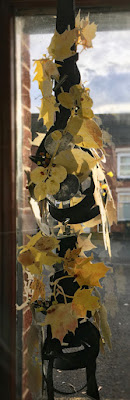
Crow Papers - hanging 


This is Crow Papers, which I installed last week at Crow Recycling Scapstore. It's part of a programme of commissions by visual artists based in Coventry designed to bring visual art out of Coventry City of Culture into the suburbs of Coventry and towns of Warwickshire. It's affliated with Coventry City of Culture and run by Coventry Artspace - who've been brilliant. I'm really grateful to have had the chance to make this work and to get to know Crow Recycling, who are lovely and are a great resource of artist materials.

So I have to deeply apologise for creating yet another artwork that is difficult (read - impossible) to photograph as one whole thing without getting all manner of things in the background of the shot, but nevermind, the sun was shining intermittantly on the day of install, so I managed to get some photos of detail.

I've been involved in the Artist on My Street project from the beginning of all the commissions as producer of the audio guide that features each of the artist windows. So, for a change I'm not going to go into great detail here about the work as I have created both an onsite audio guide via Echoes LINK (It's a free app and you can be there or listen offline) and also a longer personal podcast on Soundcloud - which is my first podcast, so we will have to see how that goes.

However, here are some of my research photos from October this year, of inside Crow and around about Hillfields.

Hillfields is an area with a number of economic and social challenges to its fabric, but that in itself presents an interesting subject, especially since the places where other species interact are usually where humans are not, or where we have left untidy spaces, therefore I consider Hillfields to be quite rich in diversity because of its unkemptness, and I really enjoyed my hours spent exploring there. 

A few photos of the work in production. The silvery stuff is an insulation board left from my Silverhouses project. It's been really useful to use as a guide for layout and I really miss not using them in the actual installation. Sadly, it's about 2.5 inches thick and there is no room at the bottom of the stairs at Crow.